
Connecticut
Chimney Flashing Repair in Connecticut
Chimney flashing repair across Connecticut for the metal seal where the chimney passes through the roof. Request a free estimate.
The Joint Between Two Things That Move
A chimney is masonry sitting on the ground; a roof is timber that moves with temperature and load. Where the two meet there is a gap that has to be sealed and has to tolerate movement, and flashing is what does it.
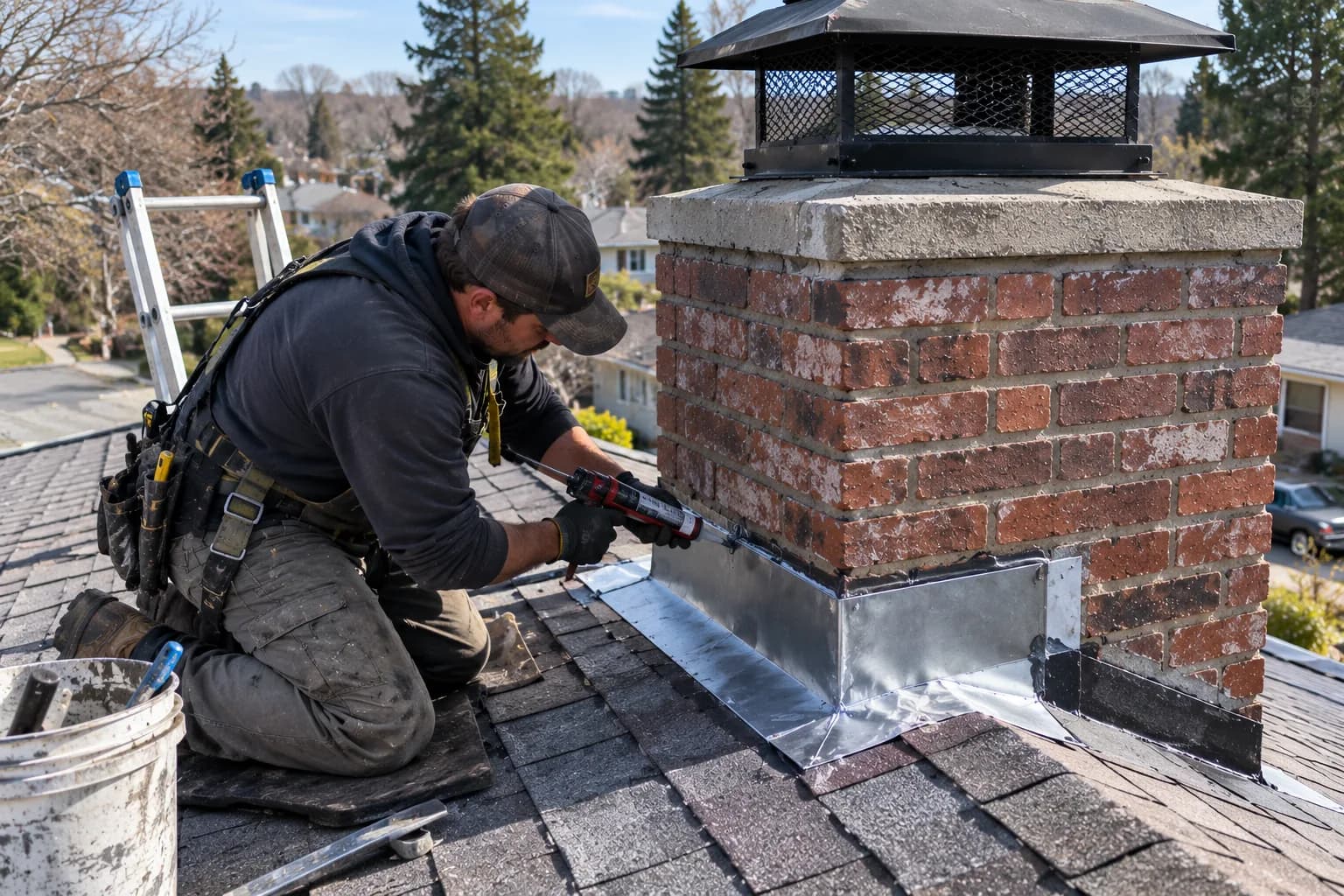
Done properly it is two layers. Step flashing runs up the sides in pieces, woven in with the shingle courses. Counter flashing is let into a mortar joint in the brickwork and folded down over the step flashing, so water running down the stack is directed out onto the roof rather than behind it.
Failure comes from movement, corrosion, or a shortcut at the original installation — most commonly counter flashing surface-mounted and sealed rather than let into the masonry. Sealant has a life measured in a few years outdoors; a properly let-in flashing has a life measured in decades.
What Flashing Failure Looks Like
Flashing leaks have a recognisable pattern, which is useful because the flashing itself is hard to see.
Staining on the ceiling near the chimney breast
Classic flashing pattern — water entering at roof level rather than at the top of the stack.
Damp in an attic around the chimney
The clearest place to confirm it, because you can often see where the water is tracking.
Tar or sealant smeared around the base
Evidence of a previous attempt. Tar over flashing is a holding measure that eventually fails.
Lifted, bent or corroded metal
Visible from a ladder or a neighboring roof, and usually the result of movement or age.
A leak that started after roof work
Flashing is frequently disturbed when shingles are replaced and not always reinstated properly.
Leaks in driving rain only
Wind-driven water gets behind a marginal flashing detail when ordinary rain does not.
Repairing It Properly
The failed metal comes off, along with whatever sealant or tar has been applied over it. New step flashing is woven in with the shingle courses up both sides, and new counter flashing is cut into a mortar joint in the brickwork and folded down over it.
The joint is then pointed and sealed — but as the last step rather than as the repair itself. The distinction matters: flashing that works does so because of how the metal is layered, not because of what has been smeared over the top of it.
Where the masonry itself has deteriorated at the roof joint, that gets addressed first. There is no point letting counter flashing into mortar that is failing.
Frequently Asked Questions
Is flashing a roofing job or a chimney job?
It is the joint between them, which is why each trade sometimes points at the other. What matters is that it is done as layered metal let into the masonry rather than sealed over, and that whoever does it is comfortable working on both.
Can it just be sealed?
It can be, and it will hold for a while. Sealant and tar over flashing are holding measures with a life of a few years outdoors — useful to stop a leak before winter, not a repair.
The leak started after we had the roof done.
That is a common sequence. Flashing has to be disturbed to replace shingles around a chimney and is not always reinstated as layered metal afterwards. It is worth looking at specifically.
How do I know it is the flashing and not the crown?
Pattern and place. Flashing leaks show up at or near ceiling level close to the chimney breast, and are often visible in the attic where the stack passes through. Crown leaks travel further down inside the stack before they appear.
What is counter flashing?
The upper layer — metal let into a mortar joint in the brickwork and folded down over the step flashing beneath. It is what directs water running down the stack out onto the roof instead of behind the flashing.
Related Leak Work
Chimney Leak Repair
The wider diagnosis — the four places water gets in.
Chimney Crown Repair
The other common entry point, higher up.
Chimney Masonry Repair
Where the brickwork at the roof joint has deteriorated.
Chimney Waterproofing
For masonry that is absorbing rather than leaking at a joint.
Chimney Leaking When It Rains
How to narrow down where the water is getting in.
Chimney Flashing Repair by Town
Towns with their own chimney flashing repair page. Service is available in all 169 Connecticut municipalities, with or without a page.
- Stamford
- Bridgeport
- New Haven
- Hartford
- Waterbury
- Norwalk
- Danbury
- New Britain
- West Hartford
- Greenwich
- Fairfield
- Milford
- Stratford
- Hamden
- Bristol
- Meriden
- Manchester
- Wallingford
- Southington
- East Hartford
Request a Free Estimate
Leak at the Roof Joint?
Tell us where the stain appears and whether it happens in all rain or only driving rain. If you can get into the attic and look at where the chimney passes through, that is the most useful thing you can tell us.
- Tell us the symptom, not the service
- No quote before someone has looked
- No obligation, no pressure
Ask About Flashing Repair
A few details is all we need to get started.