Connecticut
Chimney Repair in Connecticut
Chimney repair across Connecticut for cracked masonry, failing mortar, damaged crowns and flashing, and water getting in. Request a free estimate.
What Chimney Repair Covers
A chimney is a stack of separate components that fail in different ways and on different timescales, so "chimney repair" is really a family of jobs. The mortar joints between the bricks. The brick faces themselves. The crown, which is the sloped slab across the top. The cap over the flue opening. The flashing where the stack passes through the roof. The liner inside. The smoke chamber where the firebox narrows into the flue.
Most repairs address one or two of those. The reason it is worth knowing the names is that the same visible symptom — damp on a ceiling, say — can come from four of them, and fixing the wrong one leaves you with the same problem and a bill.
The other thing worth knowing is that deterioration is a sequence, not an event. Water gets into an open joint, freezes, expands, opens it further. The brick face starts to spall. The crown cracks and lets more water in. Caught at the joint stage this is repointing; caught much later it is a rebuild. Nearly everything in this cluster is an argument for looking sooner.
What Tells You a Chimney Needs Repair
Most of these are visible from the ground or from inside the house. None of them are self-diagnosing, but each points somewhere specific.
Mortar missing or crumbling between bricks
The first stage of masonry failure, and the cheapest point to intervene.
Brick faces flaking or falling away
Spalling — water has got into the brick itself and frozen. It does not reverse.
Pieces of masonry in the garden or on the roof
Something above is coming apart, and the stack should be looked at before the next storm.
Damp, staining or a smell after rain
Water is getting in — usually at the crown, the cap, the flashing or through open joints.
A visible crack across the top of the stack
A cracked crown puts water straight into the chimney's core.
White powdery deposits on the brickwork
Efflorescence: salts carried out of the masonry by moisture moving through it.
A stack that is visibly leaning or bowing
Structural, and the one symptom on this list that should not wait.
How a Repair Is Approached
It starts with establishing what is actually wrong, which is not always what is visible. A leak is the clearest example: the water shows up inside, often several feet from the chimney, and the entry point can be any of four places at the top or the roof joint.
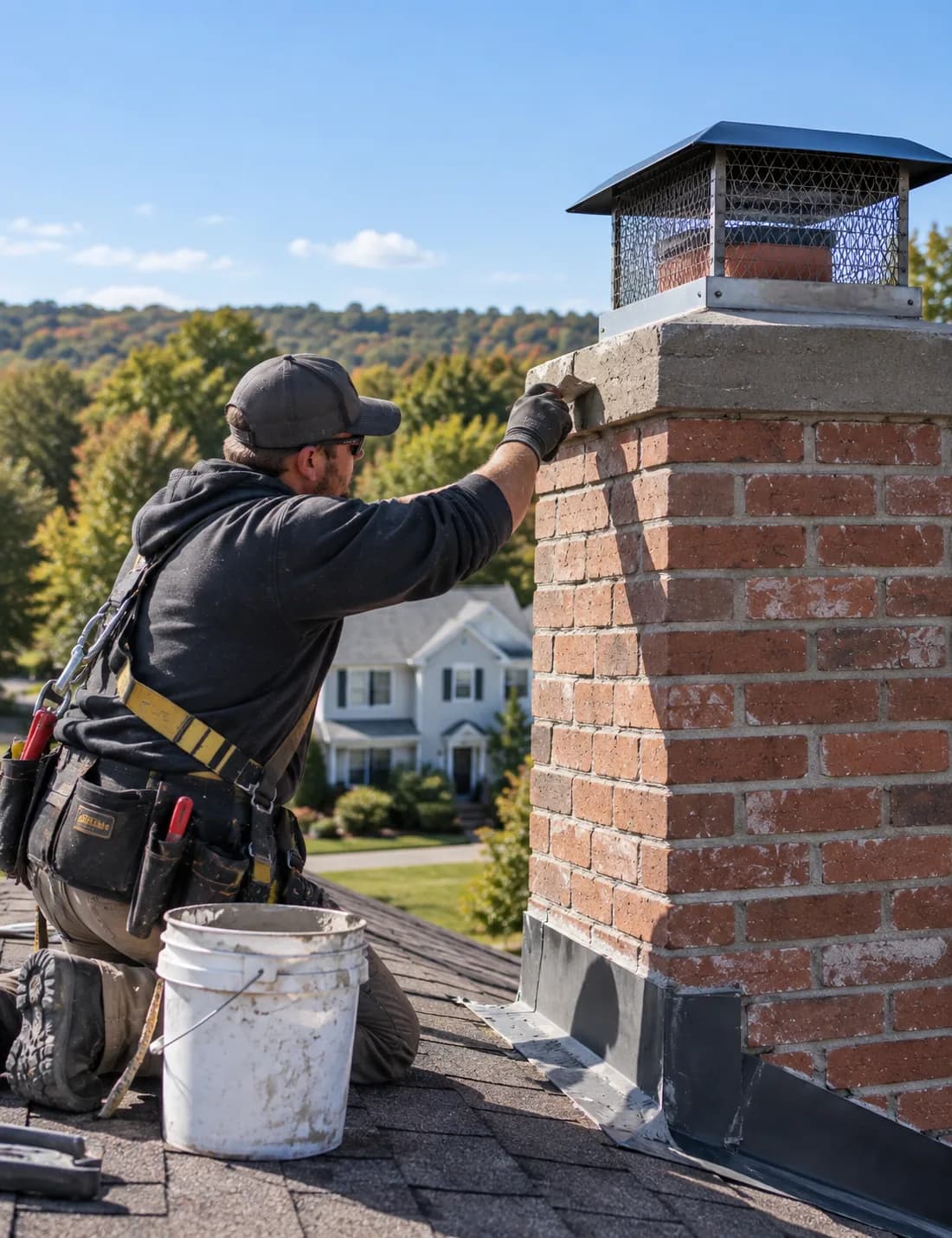
Once the cause is identified the repair follows the component. Open joints are cut out and repointed with matched mortar. Spalled brick is cut out and replaced. A cracked crown is repaired or recast. Flashing is lifted, reset and resealed. A deteriorated liner is repaired or relined. A stack past the point of economic repair is rebuilt, usually from a sound course upwards rather than from the ground.
What matters in the conversation is sequence and scope: what has to be done now, what can wait a season, and what is worth doing at the same time because the access is already there. Crown work and cap fitting, for instance, both happen at the top of the stack.
Repair or Rebuild?
This is the question that worries people most and it usually has a better answer than expected. Most chimneys that look alarming are repairable — the damage is concentrated in the mortar and the top few courses, which are the most exposed parts.
A rebuild becomes the sensible answer when the deterioration is structural rather than surface: when the brickwork has lost enough mortar that the stack is no longer stable, when spalling has gone deep across a large area, or when the stack is out of plumb. Partial rebuilds — taking the chimney down to a sound course and rebuilding upward — are far more common than full ones.
The honest version of this conversation includes what happens if you wait, because for some repairs the answer is "not much for a year" and for others it is "considerably more work next spring".
What Is Urgent and What Is Not
Open mortar joints and a missing cap are not emergencies. They are the kind of thing that costs more the longer it is left, which is a different category from something that needs attention immediately.
What does need immediate attention: a stack that is leaning, bowing or shedding masonry; a chimney after a chimney fire, because liner damage is invisible from the room; and any situation where a carbon monoxide alarm has sounded — in which case stop using the fireplace, get everyone out and call emergency services rather than waiting for an appointment.
Between those two extremes sits most of the work. A leak is worth addressing before winter rather than after it, because water in masonry that then freezes is what turns a small repair into a large one.
Frequently Asked Questions
How do I know which chimney repair I need?
Usually you do not, and that is fine — describe what you can see or what is happening. Damp on a ceiling, crumbling mortar, pieces of brick in the garden and a fireplace that has started smoking all lead somewhere different, and the cause decides the repair.
Water is coming in near the chimney. Where is it getting in?
Four usual places: the crown across the top of the stack, the cap over the flue opening, the flashing where the chimney meets the roof, and the masonry itself once the joints have opened. Establishing which is the whole job — sealing the wrong one leaves you with the same leak.
Does a chimney that looks bad need rebuilding?
Usually not. Most of what looks alarming from the ground is mortar and surface damage on the most exposed courses, which is repointing and brick replacement rather than reconstruction. A rebuild is for structural failure — a stack out of plumb, or deep spalling across a large area.
Can chimney repairs be done in winter?
Some can and some genuinely cannot: mortar and masonry work need temperatures above a certain point to cure properly, so repointing and rebuilding are warm-weather jobs. Leak work, cap fitting and interior repairs are less constrained.
My roofer says it is the chimney and my mason says it is the roof.
They are both often right, because the flashing is the joint between the two. Flashing failure is the single most common cause of a leak in this area, and it is chimney work rather than roof work in the sense that matters: it is about the seal around the stack.
How long should a chimney repair last?
That depends entirely on which repair, and anyone giving a single number is guessing. Repointing done with matched mortar on a sound stack is a long-term fix; sealing a crack in a crown that is failing across its whole area is a holding measure. We will tell you which one you are getting.
Specific Chimney Repairs
Each of these is a repair in its own right. If you know which component is the problem, start there.
Chimney Leak Repair
Water getting in at the crown, cap, flashing or masonry.
Chimney Masonry Repair
Brick and mortar work on the stack itself.
Chimney Crown Repair
The sloped slab across the top, and a frequent entry point for water.
Chimney Liner Repair
Cracked tiles or gaps in the flue's inner surface.
Chimney Tuckpointing
Cutting out and replacing failed mortar joints.
Chimney Rebuild
When repair is no longer the sensible option.
Chimney Repair by Town
Chimney Repair has its own page in 48 Connecticut towns. These are the largest; every other town is covered too and listed on the service areas page.
- Stamford
- Bridgeport
- New Haven
- Hartford
- Waterbury
- Norwalk
- Danbury
- New Britain
- West Hartford
- Greenwich
- Fairfield
- Milford
- Stratford
- Hamden
- Bristol
- Meriden
- Manchester
- West Haven
- Cheshire
- Wallingford
- Southington
- Trumbull
- Glastonbury
- East Hartford
- Enfield
- Shelton
- Torrington
- Middletown
Request a Free Estimate
Need a Chimney Repair?
Describe what you can see or what the chimney is doing — a photograph from the ground helps more than you would think. We’ll follow up about what it is likely to be.
- Tell us the symptom, not the service
- No quote before someone has looked
- No obligation, no pressure
Request a Chimney Repair Estimate
A few details is all we need to get started.