Connecticut
Chimney Cleaning in Connecticut
Chimney cleaning and sweeping across Connecticut, for flues carrying soot and creosote buildup or overdue a sweep. Request a free estimate for service in your area.
What Chimney Cleaning Actually Addresses
Every time you burn wood, the smoke leaving the firebox cools as it travels up the flue. What condenses on the way out is creosote — a tar-like residue that sticks to the flue walls and, unlike ordinary soot, is flammable. Cleaning is how that layer comes back off.
Alongside creosote, a flue collects loose soot, ash carried up by the draft, crumbled mortar or liner material, and anything that has found its way in from the top: leaves, twigs, nesting material. A cleaning clears the passage so the chimney can vent the way it was built to.
It is worth being clear about what cleaning does not do. It does not repair a cracked flue tile, reseal flashing, rebuild a crown or stop a leak. Those are repairs. Cleaning removes what has accumulated inside — and, because the technician is looking at bare flue walls once the deposits are gone, it is often the point at which a problem is first noticed.
Signs a Chimney May Need Cleaning
There is no single symptom that proves a chimney is due. These are the ones that most often turn out to matter — and any of them can also point at a repair issue rather than a cleaning one, which is why a look up the flue settles it.
Smoke coming back into the room
A flue that has narrowed with buildup, or is partly blocked, cannot carry smoke away fast enough.
A strong smell from the fireplace
Creosote has a sharp, tarry odor that gets worse in warm, humid weather or when the damper is open.
Visible black, shiny or flaky deposits
If you can see buildup on the damper or the upper firebox, there is more of it further up.
Fires that are hard to start or keep going
Poor draft can be buildup, a blockage, or something structural. It is worth finding out which.
Debris falling into the firebox
Twigs, leaves or nesting material mean something is getting in at the top.
A season of regular burning since the last clean
How fast creosote accumulates depends on how much you burn, what you burn and how the fire is run.
What a Chimney Cleaning Typically Involves
The order varies with the chimney, but the shape of the job is consistent.
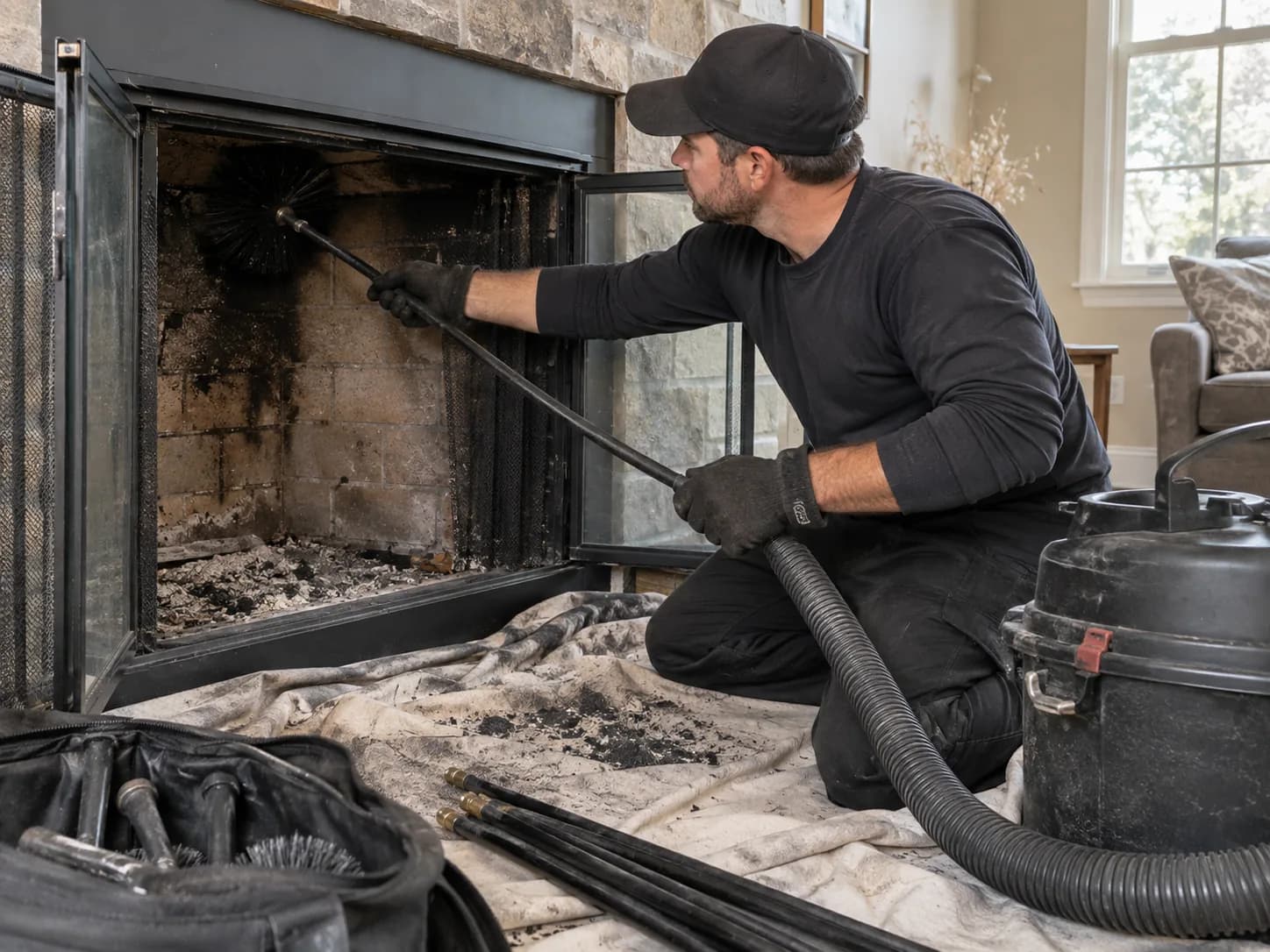
The work area is covered and a vacuum is set up at the fireplace to keep soot contained — a cleaning done properly should not leave a black mark on the room. The technician then works the flue with brushes and rods sized to it, from below, from the roof, or both, depending on how the chimney is built and what access it allows.
Deposits are cleared from the smoke chamber, the smoke shelf and the damper area as well as the flue itself, because that is where a surprising amount of it settles. The firebox is cleaned out, the debris is collected, and the technician tells you what the flue looked like once it was bare.
That last part is the part worth paying attention to. Cracked tiles, a gap in the liner, a damper that no longer seals, daylight where there should not be daylight — these are visible during a cleaning and invisible the rest of the time.
Chimney Cleaning or Chimney Sweep — Is There a Difference?
For standard work, no. "Chimney sweep" is the older trade term and it is still what many people search for; "chimney cleaning" describes the same job. A company advertising sweeping and a company advertising cleaning are, in the ordinary case, offering the one service.
The word can mean two things, which is where the confusion comes from: a sweep is both the person and the job. So "we need a chimney sweep" and "we need a chimney cleaning" are the same request.
You will also see "flue cleaning" and "chimney flue cleaning". The flue is the passage the smoke travels through, so cleaning the flue is the substance of cleaning the chimney. We treat all of these as one service rather than splitting them into separate offerings that would only make the choice harder.
One exception worth knowing: flues serving oil, boiler or furnace appliances are a different job with different requirements, and are not covered here.
Creosote, Soot and Buildup
Soot is the fine black powder left by combustion. It is messy and it narrows a flue over time, but on its own it is not the reason cleaning matters most.
Creosote is. It forms when wood smoke condenses on a cooler flue wall, and it accumulates faster when fires burn cool and slow, when wood is damp or unseasoned, or when a flue is oversized for the appliance and the smoke has time to cool before it leaves. Because creosote is combustible, a thick enough layer inside a flue is a fire risk in a way that ordinary soot is not.
It also hardens as it ages. Fresh deposits are flaky and brush away readily. Left long enough, creosote can bake into a hard, glazed layer that a standard cleaning will not remove — that is a different and more involved job, and a technician should tell you plainly if that is what they have found rather than brushing at it and calling it done.
Blockages: Nests, Debris and Fallen Material
An obstruction is the other thing a cleaning clears. Birds and squirrels build in uncapped flues, leaves and twigs collect at the top, and inside the chimney a cracked crown or a failing liner sheds material that lands on the smoke shelf.
A blockage behaves differently from gradual buildup. Buildup creeps up over a season or two; a blockage tends to appear suddenly — a fireplace that drew fine last winter and now pushes smoke into the room, or debris turning up in the firebox that was not there before.
Clearing it is part of the same visit. What matters afterwards is why it happened: an open flue that has taken in a nest will take in another one, which is usually a conversation about a cap rather than about cleaning again next year.
How Cleaning and Inspection Fit Together
They answer different questions. A cleaning removes what has built up. An inspection assesses condition — whether the flue, liner, crown, cap and connections are sound.
In practice they overlap, because a flue is far easier to assess once it is clean, and a technician cleaning a chimney is looking at it the whole time. If you are booking one service and something is actually wrong, the cleaning is usually where it surfaces.
They are worth booking separately when the question is specific: buying a house, after a chimney fire, after a storm, or when changing what the chimney vents. In those cases the condition assessment is the point, not the cleaning.
Frequently Asked Questions
Is chimney cleaning the same as chimney sweeping?
For standard work, yes. "Sweep" is the traditional trade term for both the job and the person doing it; "cleaning" describes the same service. If a company offers one, they are offering the other.
Does chimney cleaning remove creosote?
It removes ordinary creosote and soot deposits, which is most of what accumulates from regular burning. Creosote that has aged into a hard glazed layer is a different, more involved job — a technician should tell you if that is what they find rather than treating it as a standard clean.
How often does a chimney need cleaning?
It depends on how much you burn rather than on the calendar. A fireplace used most winter evenings accumulates deposits far faster than one lit a few times a year. The practical answer is to have it looked at before the burning season and let the condition of the flue decide.
Should the chimney be inspected when it is cleaned?
A technician cleaning a flue is looking at it throughout, so obvious problems tend to surface. A separate inspection is worth booking when you need a condition assessment for a specific reason — a home purchase, a chimney fire, storm damage, or changing what the chimney vents.
Is chimney cleaning messy?
It should not be. The hearth and surrounding area are covered and a vacuum runs at the fireplace to contain soot while the flue is brushed. Containment is part of doing the job properly, not an extra.
Does a gas fireplace need cleaning too?
A gas fireplace does not produce creosote the way a wood fire does, so it is a different job — the venting, burner and glass need attention rather than the heavy flue deposits wood burning leaves behind. Tell us it is gas when you get in touch and we will handle it accordingly.
My chimney seems blocked. Is that a cleaning?
Usually, yes — clearing an obstruction is part of the same visit, whether it is a nest, fallen debris or heavy buildup. What matters afterwards is preventing a repeat, which for an uncapped flue means fitting a cap rather than clearing it again next year.
Related Chimney Services
Cleaning is often the first thing booked. These are what it most often leads to.
Chimney Inspection
A condition assessment when you need to know what state the chimney is in.
Chimney Repair
Cracked masonry, deteriorated mortar, leaks and crown damage.
Chimney Cap Installation
Stops the debris and animal entry that cause most blockages.
Chimney Liner Repair
When the flue's inner surface is cracked, gapped or deteriorating.
Fireplace Smoking
Smoke coming into the room — what causes it and which service usually fixes it.
Blocked Chimney
How an obstruction shows itself, and what it usually turns out to be.
Chimney Cleaning & Inspection
Both jobs in one visit, in the order that makes each work better.
Chimney Cleaning by Town
Chimney Cleaning has its own page in 48 Connecticut towns. These are the largest; every other town is covered too and listed on the service areas page.
- Stamford
- Bridgeport
- New Haven
- Hartford
- Waterbury
- Norwalk
- Danbury
- New Britain
- West Hartford
- Greenwich
- Fairfield
- Milford
- Stratford
- Hamden
- Bristol
- Meriden
- Manchester
- West Haven
- Cheshire
- Wallingford
- Southington
- Trumbull
- Glastonbury
- East Hartford
- Enfield
- Shelton
- Torrington
- Middletown
Request a Free Estimate
Need Your Chimney Cleaned?
Tell us how the fireplace is behaving and roughly how often you burn, and we’ll follow up about scheduling.
- Tell us the symptom, not the service
- No quote before someone has looked
- No obligation, no pressure
Request Chimney Cleaning
A few details is all we need to get started.