Chimney & Fireplace Problems
Chimney Leaking When It Rains
Water appearing near a chimney has almost never got in where you can see it. Working out the entry point is the whole job, and the pattern of the leak gives most of it away.
Why the Stain Is Never Where the Leak Is
A chimney is the one part of a roof that deliberately puts a hole in it, then stands several feet above the roofline taking weather on all four sides. Water gets in more readily here than almost anywhere else on a house.
Once it is in, it travels. Down the inside of the stack, along a rafter, across a ceiling joist, and out wherever it finds a gap. A damp patch three feet from the chimney breast is completely normal and tells you nothing on its own about where the water entered.
That is why sealing the visible thing is such a common and expensive way to still have a leak. The diagnosis has to happen at the top of the chimney, not at the stain.
The Four Places Water Gets In
Nearly every chimney leak is one of these, and each produces a slightly different pattern.
The crown
The sloped slab across the top. Cracked, it puts water straight into the core of the stack, which then appears well below.
The cap
The cover over the flue opening. Missing or corroded, and rain falls directly down the flue — often showing as damp in the firebox itself.
The flashing
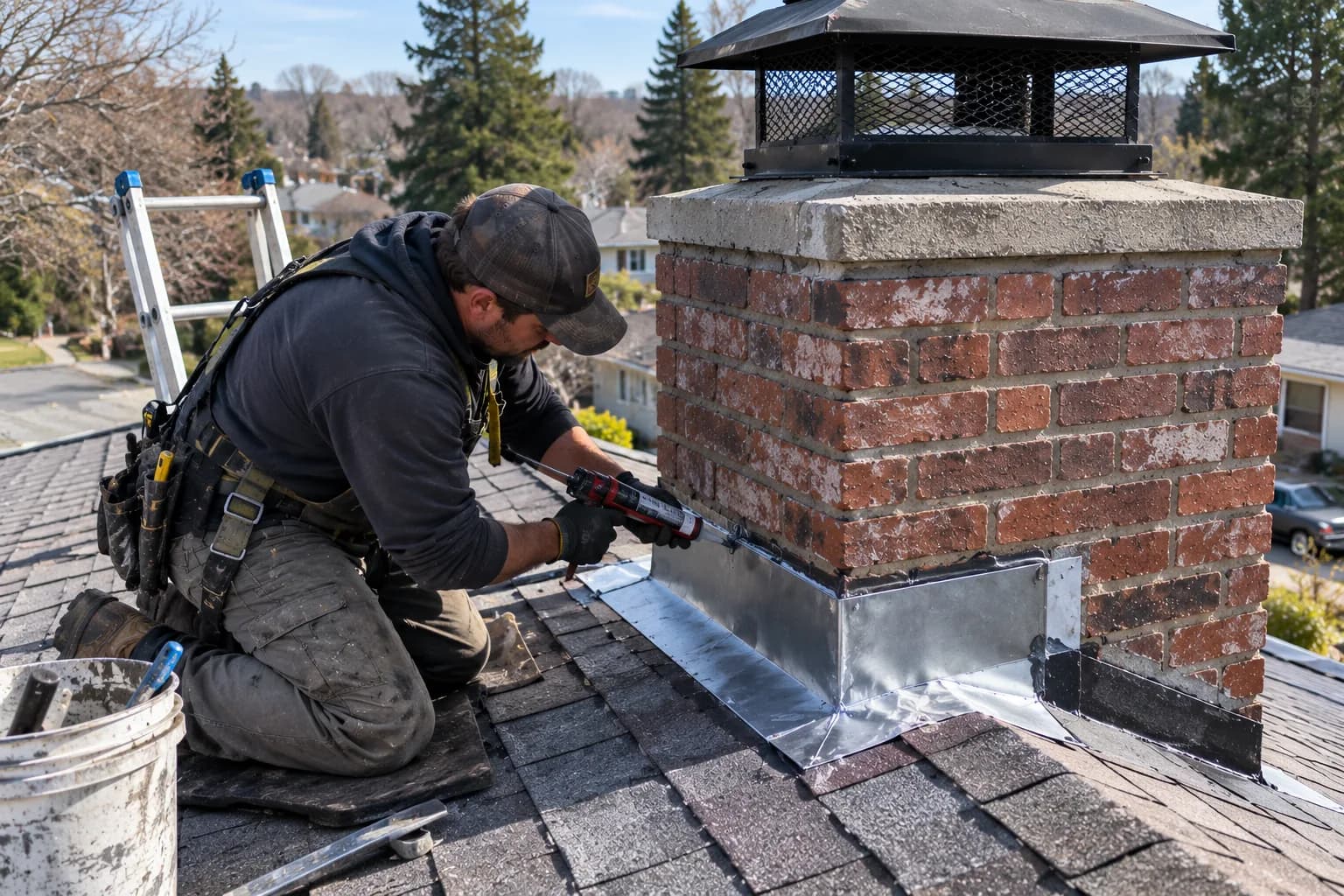
The metal seal where the chimney passes through the roof. The most common single cause, and usually blamed on the roof.
The masonry
Brick is porous. Once mortar joints have opened, the stack absorbs water across its whole face and releases it inside.
Condensation, which is not a leak
An oversized or unlined flue can produce moisture that behaves like a leak and needs a different answer entirely.
A gapped liner
Less common as a water route, but a damaged liner lets combustion moisture into the masonry from the inside.
Narrowing It Down From Inside the House
Where does the water appear? In the firebox itself points at the cap or the flue. At ceiling level on or near the chimney breast points at the flashing. Higher up inside the stack, appearing further from the breast, points at the crown.
When does it happen? Every time it rains suggests a direct route in. Only in heavy or driving rain suggests absorption through the masonry, or a flashing detail that ordinary rain does not reach.
Did it start suddenly? A leak that appeared after a storm usually means something failed — a cap blown off, flashing lifted, a crown cracked over a hard winter. A leak that has crept up over years is usually mortar and masonry.
If you can get into the attic during or just after heavy rain and look at where the chimney passes through, you will often see exactly where the water is tracking. That single observation is worth more than anything else you can do from the ground.
Why This Is More Urgent Than It Feels
A slow chimney leak looks like a cosmetic problem for a long time. It is not, because of what Connecticut winters do to wet masonry.
Water inside brick and mortar freezes, expands by roughly a tenth of its volume, and pushes the material apart. Then it thaws and does it again. A stack goes through that cycle repeatedly over a single winter, and the damage is cumulative and irreversible — it is the mechanism behind open mortar joints, spalled brick faces, and eventually a rebuild.
A leak found in the fall and dealt with before the freezing starts is a far smaller job than the same leak found in spring.
A sealant smeared over a failing crown or across open joints is a holding measure, not a repair — and a non-breathable coating on masonry traps water inside, which makes the freeze-thaw damage worse rather than better.
Frequently Asked Questions
Is this a roof problem or a chimney problem?
Very often it is the flashing, which is the joint between the two — and that is the most common single cause of a leak in this area. Your roofer can be entirely right that the roof is sound and the leak can still be there.
It only leaks in heavy rain. What does that mean?
Usually masonry absorption: the brick takes up water faster than it can shed it and releases it inside. Driving rain from one direction can also reach a flashing detail that ordinary rain does not.
There is water in the firebox itself.
That points at the cap or the flue rather than the flashing or the masonry — rain is coming straight down the flue. It is also the one pattern with the simplest fix, since capping an open flue is among the least involved jobs there is.
Can I just seal the chimney?
Sealing the right thing works. Sealing the visible thing usually does not, and some coatings actively make it worse — a non-breathable sealer over brick traps moisture inside the masonry where it freezes and does more damage than the leak did.
How long can it wait?
Ideally not through a winter. Wet masonry going through repeated freezing and thawing is what turns an open joint into a rebuild, so the season matters more than the size of the stain.
The Repairs a Leak Leads To
Which one depends entirely on where the water is getting in.
Chimney Leak Repair
The service page — diagnosis and the repair that follows.
Chimney Flashing Repair
The roof joint, and the most common cause.
Chimney Crown Repair
The slab at the top of the stack.
Chimney Cap Installation
When rain is coming straight down an open flue.
Chimney Waterproofing
For masonry absorbing water rather than leaking at a point.
Chimney Inspection
What establishes which of the four it actually is.
Request a Free Estimate
Water Coming In Near the Chimney?
Tell us where the stain appears, whether it happens in all rain or only heavy rain, and whether it started suddenly. Those three answers narrow it a long way.
- Tell us the symptom, not the service
- No quote before someone has looked
- No obligation, no pressure
Describe the Leak
A few details is all we need to get started.