Chimney & Fireplace Problems
Fireplace Not Working
Most fireplaces that stop working are gas units, and gas units fail in identifiable patterns. What it does, and when it does it, narrows the cause a long way.
Start With What Kind of Fireplace It Is
A wood fireplace that will not work is almost always a draft problem — the flue is restricted, cold, or the house is competing for air. It is rarely the fireplace itself.
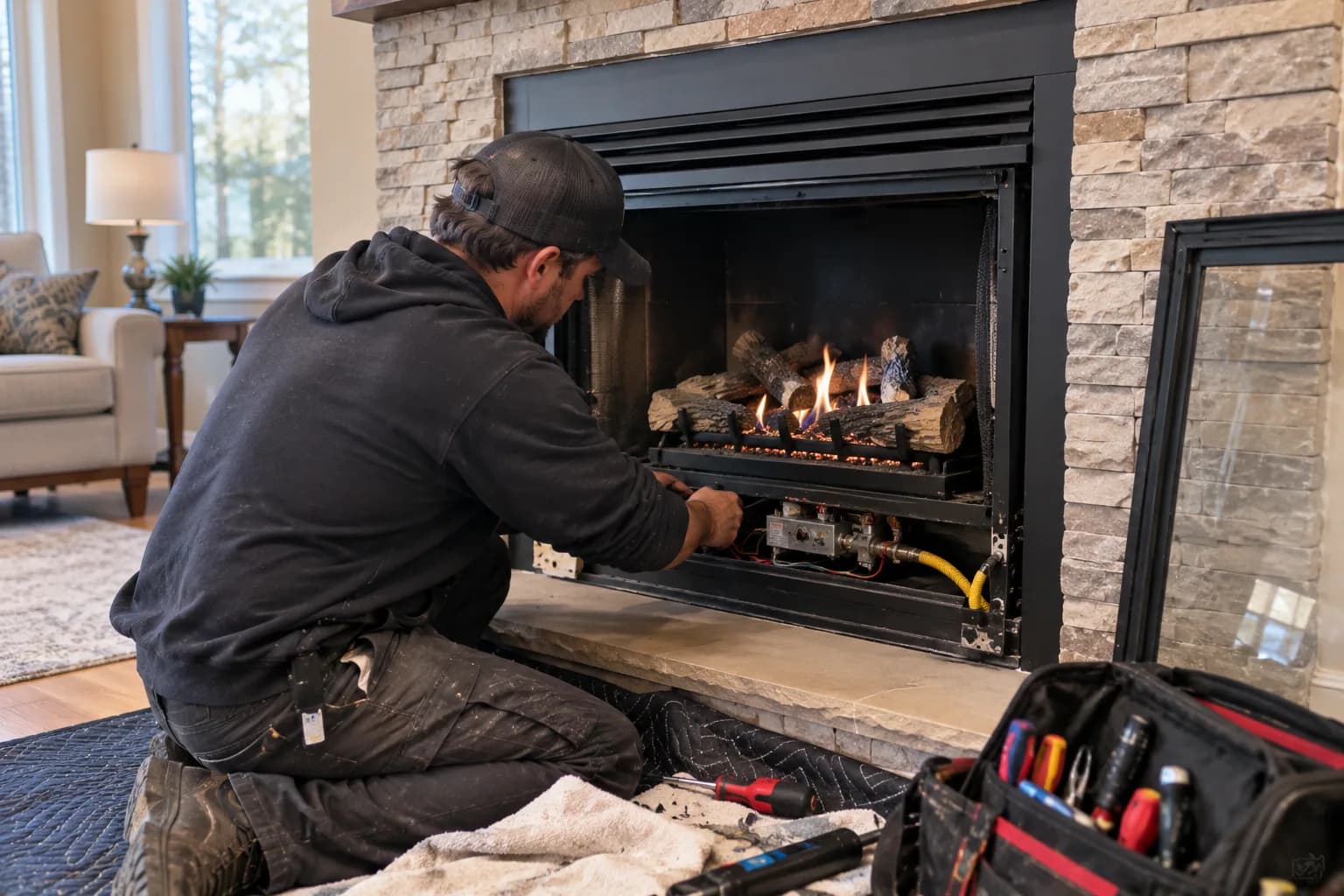
A gas fireplace that will not work is almost always the appliance. There is a pilot assembly, a thermocouple or thermopile proving the pilot is lit, an igniter, a gas valve and the venting, and one of those five accounts for the large majority of faults.
So the first useful thing is to establish which you have. A gas unit has a burner and either a standing pilot light or an electronic igniter that clicks. A wood fireplace has neither.
What Each Symptom Points At
On a gas unit the symptom maps to the component more reliably than on almost anything else in a house.
Pilot lights, goes out when you release the knob
The thermocouple or thermopile — the safety device that proves the pilot is burning.
Clicks but will not light
Igniter, ignition electrode, or no gas reaching the burner.
Lights, then shuts down after several minutes
Often venting, or a safety switch responding to a venting problem — not the burner.
Nothing at all, no click, no pilot
Power, batteries in the receiver, the gas supply, or the valve.
Remote or wall switch does nothing
Frequently the simplest of the lot — batteries, pairing, or the receiver.
Burns with a lazy yellow flame and soots
Incomplete combustion. Worth stopping use of the unit until it has been looked at.
Worth Checking Before You Call
A surprising share of dead fireplaces are not faults. Is the gas supply on — including any isolation valve near the unit, which gets turned off and forgotten? Is there a wall switch, and is it on? Are there batteries in the remote and, separately, in the receiver module behind or under the unit, which is the one people do not know exists?
Is there a service switch on the appliance itself? Many units have one, and many are found in the off position after a decorating job or a house move.
None of that is a substitute for a proper diagnosis, but it takes two minutes and it resolves more of these than you would expect.
If you smell gas, do not attempt to light the fireplace or operate any electrical switch. Leave the property and contact your gas supplier or emergency services from outside.
If It Is a Wood Fireplace
Then "not working" almost always means it will not draw. A fire that will not establish, goes out when the kindling burns through, or pushes smoke into the room is describing a draft problem rather than a broken fireplace.
The usual causes are a partly closed damper, a cold flue, a restricted or blocked flue, or a house sealed tightly enough that the fire cannot get the air it needs. Those have completely different fixes, and the poor draft and smoking pages go through how to tell them apart.
Frequently Asked Questions
The pilot lights but goes out when I let go of the knob.
That is the classic thermocouple or thermopile signature. The device senses the pilot is burning and holds the gas valve open; when it fails, the valve closes as soon as you stop holding it manually. It is a common fault and a replaceable component.
It runs for a few minutes and then shuts itself off.
Often a venting issue, or a safety switch responding to one, rather than a problem with the burner. That pattern is worth reporting specifically because it directs the visit at the vent rather than the appliance.
It is completely dead. What should I check?
The gas isolation valve near the unit, any wall switch, the service switch on the appliance itself, and batteries — both in the remote and in the receiver module behind or under the fireplace. That last one catches a lot of people.
Our wood fireplace will not stay lit.
That is a draft problem rather than a fireplace fault. A cold flue, a partly closed damper, a restriction in the flue, or a house too tightly sealed for the fire to get air are the usual causes, and they have different fixes.
It works but there is black soot on the glass and logs.
Sooting on a gas appliance means combustion is incomplete, which can come from log placement, blocked burner ports or an air supply problem. It is worth stopping use of the unit until it has been looked at rather than carrying on.
What Usually Fixes It
Gas Fireplace Repair
Pilot, thermocouple, igniter, valve and venting faults.
Fireplace Repair
The wider page across fuel types.
Poor Chimney Draft
Where a wood fireplace will not establish a fire.
Chimney Cleaning
Where the flue is restricted.
Fireplace Insert Repair
For a closed unit fitted into a fireplace opening.
Fireplace Smoking
When it lights but sends smoke into the room.
Request a Free Estimate
Fireplace Not Working?
Tell us whether it is gas or wood, exactly what it does, and the make and model if you can find it. On a gas unit that is usually enough to know what the part is.
- Tell us the symptom, not the service
- No quote before someone has looked
- No obligation, no pressure
Describe the Problem
A few details is all we need to get started.