
Connecticut
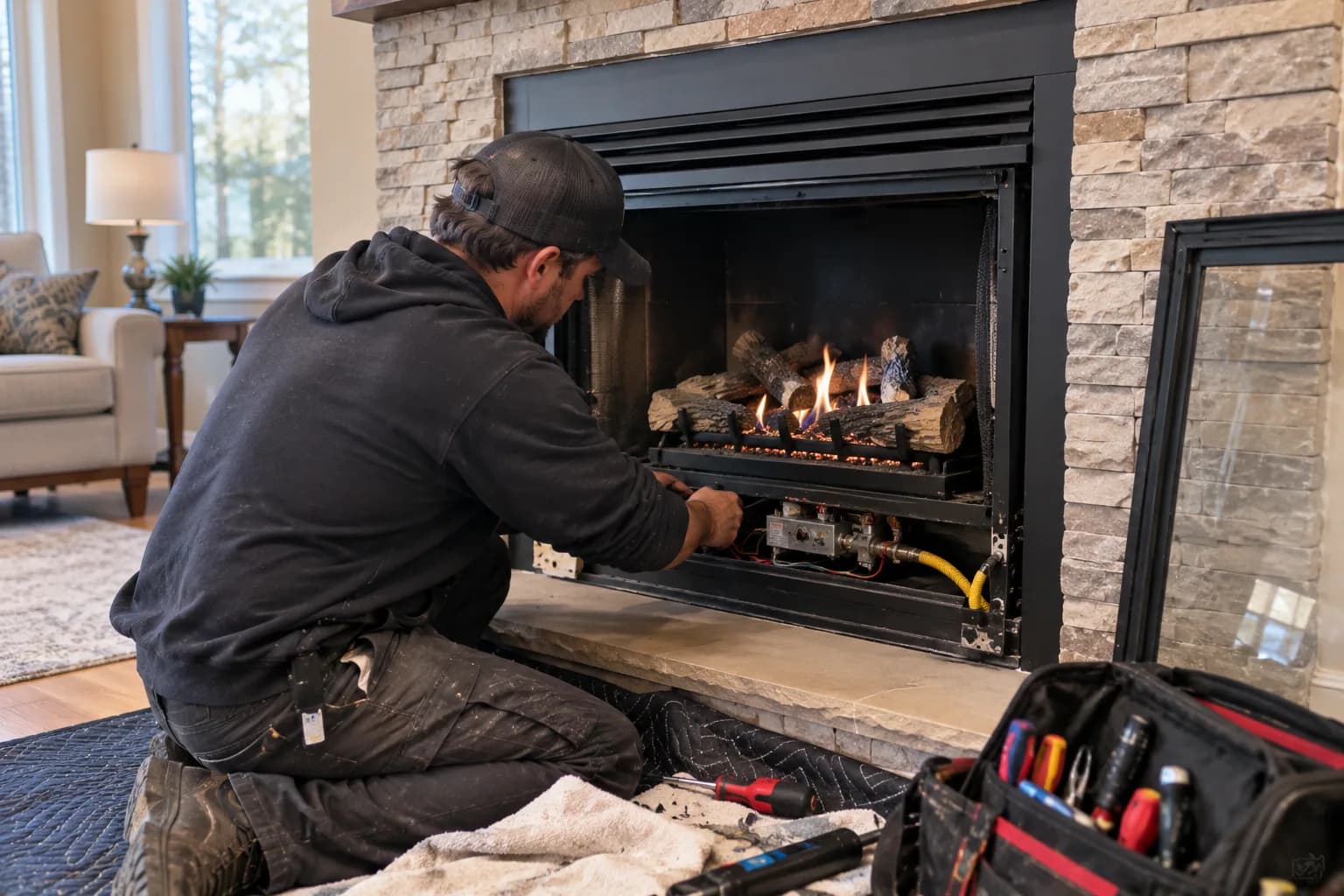
Gas Fireplace Installation in Connecticut
Gas fireplace installation across Connecticut — fitting and venting a gas fireplace, insert or log set. Request a free estimate.
Three Venting Types, Three Different Projects
A direct-vent unit is sealed: it draws combustion air from outside through one pipe and exhausts through another, usually horizontally through a wall. It does not use room air, and it can go where there is no chimney at all. It is the type most new installations use.
A natural-vent unit — sometimes called B-vent — draws room air for combustion and exhausts vertically, up a chimney or a dedicated flue. That means an existing chimney can often be used, usually with a liner sized to the appliance.
Vent-free units exhaust into the room. They are permitted in some places and not others, they add moisture to the house, and they are a genuinely contested product. We will tell you our view if you ask, but the important point is that it is a different decision from the other two rather than a cheaper version of them.
What Decides the Installation
These are the questions worth settling before choosing an appliance.
Is there an existing chimney?
It can often be used, with a liner sized to the appliance. It does not have to be.
Where in the room will it go?
A direct-vent unit needs an exterior wall route or a vertical run. Position and venting are one decision.
Is gas already supplied to the house?
Running a new supply is a separate piece of work and worth knowing about early.
Insert or a new fireplace?
An insert goes into an existing fireplace opening; a new unit is built into a wall or enclosure.
Log set or a full appliance?
A gas log set in an existing fireplace is a much smaller job with much less heat output.
What termination is available outside?
Clearances from windows, doors, soffits and the ground all constrain where a vent can terminate.
How the Work Runs
Assessment first: the position, the venting route, the gas supply and, where an existing chimney is involved, its condition and size. That assessment is what makes the rest predictable, and skipping it is how a project discovers a relining requirement halfway through.
Then the preparation — the opening or enclosure, the hearth if one is required, and the gas line to the appliance position. Then the venting, which for a direct-vent unit is the coaxial pipe run to its termination, and for a natural-vent unit is usually a liner run down the existing chimney and connected at the appliance.
Then the appliance itself, connected, commissioned and tested, with the media and glass fitted and the controls set up. And then finishing and making good.
Installation work is subject to permitting and code requirements that vary by municipality, and gas work has its own requirements in Connecticut. This site makes no claim about licenses, permits or code sign-off — those are established for the specific job.
Frequently Asked Questions
Can a gas fireplace use our existing chimney?
A natural-vent appliance can, usually with a liner sized to it — an old flue is nearly always far too large for a modern gas unit. A direct-vent appliance does not need a chimney at all and vents through a wall instead.
What is a direct-vent fireplace?
A sealed unit that takes combustion air from outside and exhausts outside through the same coaxial pipe, without using room air. It is the type most new installations use, and it can go in rooms with no chimney.
What about vent-free units?
They exhaust into the room, which is why they are treated differently from the other two and are restricted in some places. They also add moisture to the house. It is a genuinely different decision rather than a cheaper version of a vented unit, and worth discussing before choosing.
Could we just put gas logs in the fireplace we have?
Often yes, and it is a much smaller job. It is also a much smaller heat output: a log set in an open fireplace is largely an appearance change, where an insert is a heating appliance.
Is a permit needed?
It varies by municipality, and gas work has its own requirements in Connecticut. It is established for the specific job rather than assumed, and we will tell you what applies rather than making a general claim.
Related Installation Work
Gas Fireplace Repair
Servicing and fault-finding once it is in.
Fireplace Installation
The wider page across fuel types.
Chimney Liner Installation
Nearly always part of a natural-vent installation into an old chimney.
Fireplace Insert Installation
Fitting into an existing fireplace opening.
Chimney Inspection
What establishes whether an existing flue can be used.
Request a Free Estimate
Planning a Gas Fireplace?
Tell us whether there is an existing chimney, whether gas is already supplied, and whereabouts in the room it would go. Those decide the venting, and the venting decides the project.
- Tell us the symptom, not the service
- No quote before someone has looked
- No obligation, no pressure
Ask About Gas Fireplace Installation
A few details is all we need to get started.